Showing posts with label Photography. Show all posts

Tuesday, 30 May 2017

On Seeing

Seeing is believing, if you’re easy to convince. Like Thomas, I begin to think touch more reliable. Some people see things that are not there; many see things that are placed there. Wars, invasions, propaganda may depend on seeing things, present or absent. Ask a migraine subject about the flashing lights. Don’t begin to contemplate the actions of certain drugs, legal or not.
            Photography is a language:  like English, Chinese or any tongue it can be used for truth or fiction. If the devil is the father of lies, photography must be the mother, or at least the sister of lies. Why the sister? Because like Wisdom, she sees deeper than others, but any deceit plays on thoughtless unsupported concepts of veracity: seeing is believing. Many believe wordy falsehoods: even more false pictures.
            ‘I saw you,’ said Jesus, of a man in whom there was no deceit. The quality of the eye is also important. What everyone hopes to see is the truth. Deep, deep in the understanding is a precondition for identifying what the truth might be. Is it a ruthless, punishing God? No God? A merciful, availing God? May you see grace to understand the last.

Saturday, 24 October 2015

On Cropping Pictures


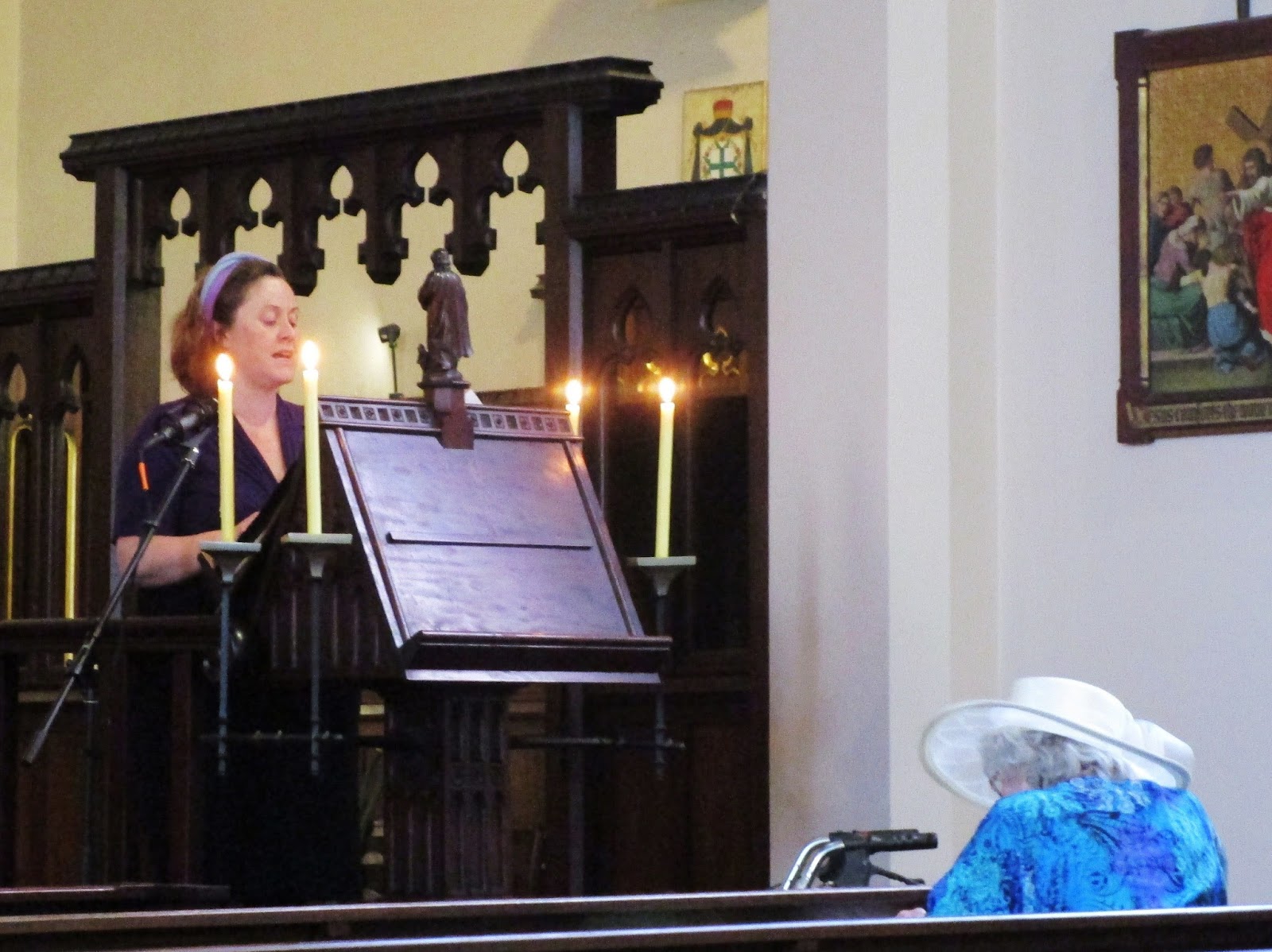
I’m a believer in cropping photographs. I don’t do much photo management: I take pictures by ambient light, flash disabled; I use a small 20 megapixel handheld digital camera; I process little. It’s my method of street photography. But I do crop. As you see, cropping changes the image from broad to intimate. The cropped version of ‘Cantor’ stresses the blue of Diana’s dress and the halo of candles surrounding Rachel, the warmth between the two women. It talks about colour. The full shot is about place, and what happens there. Rachel sings in a church that echoes the history of the colony: the city of Melbourne was proclaimed from its steps in 1848. The picture considers spaced-out churches where the aged, the disabled, the sick and the homeless — the same who came to hear Jesus — still come to hear his liturgy. It also speaks of committed musicians giving their hearts from the choir loft: here present what Britten called ‘the holy triangle’ of composer, performer, and listener. A picture about sound. Where is your field of attention? Is it close, detailed, intimate, appreciative? Or is it broad, detached, gathering experience of place and time? Which do you prefer? It was hard to decide.


Saturday, 18 July 2015

On Past Photographs


Last night I dreamed about my photographs from art school. In the morning I gathered enough energy to go downstairs and look around for them. I didn’t find what I was looking for, but I found others, that I’d forgotten, that had an important effect on my aesthetic. There was the time a roll of film got misdeveloped, producing curtainlike sheets of light. My teacher thought it fascinating; I thought it bizarre. When I printed them out, they were fascinating. There were portraits, and genre scenes at the school. The passage of time: remembering images floating up through the chemicals, and how they’ve changed by now.
            When I got to choose a major project, I decided to photograph Mont Albert Road. The school was in Box Hill, and that road is notable for beautiful trees and autumn colours. The buildings were changing. I caught it in the 1990s. And much has changed.
            What I do now owes a lot to what I did then. I was looking for the Mont Albert photographs: no doubt I’ll find them. I find them in the pictures I take today. If you take a photo on the street, you document a moment in the flow of unceasing time. The light, the relationship to beauty, the evidence of where and when. Then chemical; now digital: always changing.

Sunday, 16 June 2013

All in the Eye of God: Sex and Cameras


I believe it was William Penn who believed that you shouldn’t do in private what you wouldn’t want to be seen doing in public.Whether you have your hand in the till or up your neighbour’s skirt it’s even more likely you’ll be seen in the digital age. The ubiquitous camera whether attached to your phone or not — I carry my camera constantly, so I should know — will be recording many events of which you may have no memory, so fast they flashed by you. Some cameras direct traffic; some solve crimes. I’m not anti-camera.
            Cameras, in some cases, reflect in a sense the eye of God, sometimes understood to see all things, sometimes even to understand all things, and sometimes to condemn some things including misuse of one’s neighbour. From barrack-room ribaldry to serial rapes of teens rendered helpless by drink, to murder itself, anything can be photographed and filmed. Surely the transcendent God has seen everything; I feel it’s quite certain there’s nothing new in the lines of sin or folly under the sun, any more than there was when the Preacher was telling us all is vanity.
            So what is private, and who owns what’s public? Excepting those legitimately making a living from the sex trade, I find a number of questions around amateur cameras and possibly private activities. The past and current military scandals involving filming of sex acts between adults of controversial consent brings up the question: who owns the copyright in your sex life?  If only one person is filming, who has the distribution rights? If someone is going to make money out on the internet somewhere, who gets a cut? Did she really agree to world-wide viewing rights?  Does he actually want the facts about his manhood revealed? How drunk or drugged was anyone?
            And what is libel? I seem to think it’s loosely covered in the term ‘false witness’. Is photographing someone having sex with you and then distributing the image on the internet with demeaning text ‘false witness’? That’s actually one of the more serious sins in the Decalogue, right up there with coveting your neighbour’s ox.
            The idea of God’s all-seeing eye has been used to keep people in fear of their bodies, their desires, and their relationships. Yet God’s eye would appear to be more forgiving than the eyes of a vast impersonal viewing public, or even the eyes of the friends of your friends. “You are the God who sees me,” said Hagar the slave-girl, someone who was in a tangle of relationships in an unconsenting role. God sees all: maybe only God has the need to see everything.