Sunday, 15 November 2015

On the Father of Lies


Some words are of the devil. ‘Apartheid’, ‘segregation’, ‘separateness’ are all translated as ‘deprivation’: of civil rights, freedoms, dignity, livelihood, hope. Using terms like ‘detention centre’ and ‘resettlement’ when we mean ‘prison’ and ‘exile’ we lie with pretty words. And the devil is the father of lies.
            Desmond Tutu realised the vital nature of truth when he pointed out that the Truth and Reconciliation Commission did not issue blanket amnesty ‘… amnesty is granted only to those who plead guilty, who accept responsibility for what they have done.’ The harm to the national fabric must be spoken in order for people to be able to live together. ‘True reconciliation exposes the awfulness, the abuse, the pain, the degradation, the truth.’ Archbishop Tutu respects the power of ideology and conditioning. The commission revealed how ‘virtually every institution, every aspect of life, came under the control of this ideology. Everything conditioned white people to think and act in a particular kind of way.’ This comprehension leads to compassion, to awareness of human frailty, even the hope that some may become ‘more ready to accept accountability more easily.’[1]
            ‘Perfect repentance’, Rabbi Sacks says, ‘comes about when you find yourself in the same situation but this time you act differently.’ It’s a ‘change of heart’ preceded by ‘regret, remorse, confession.’[2] Confession of the truth.
            This is a warning against ideologies, othering, and untruths. Our time of mass migration presents a challenge to the ethics of every nation. John D’Arcy May suggests ‘that the actual acceptance of people of other faiths and traditions is itself a religious act which must spring from a spirituality of non-violence.’[3] Let us then confess our sins before God, resolving to lead a new life, hewing to the truth of what has been done and is being done by our governments and left undone by ourselves.


[1] Material in this paragraph from Desmond Tutu, No Future Without Forgiveness (London: Rider, 1999), 51;218;203;204.
[2] Jonathan Sacks, Not in God’s Name: Confronting Religious Violence, (London: Hodder and Stoughton, 2015), 154.
[3] John D’Arcy May, Transcendence and Violence: The Encounter of Buddhist, Christian and Primal Traditions (New York: Continuum, 2003), 153.

Tuesday, 10 November 2015

On 'Race' and Religion


When I was in Sydney, I knew many South Africans. Some were opponents of apartheid who’d fled imprisonment for their activism. Others were Jewish: they knew a rule basing distinctions on ‘race’ was dangerous and bad for Jews. (The Nazi conflation of religion with ‘race’ viewed religion as unchangeable, so the music of Mendelssohn, a Roman Catholic, couldn’t be played). Some were both.
            The Christian activists opposed a Christian government. Members of the Dutch Reformed Church dominated political life.[1] Many problems of European provenance devolve back to the Reformation: this is one. When Jan Van Riebeeck established it in 1652, the Dutch Reformed Church brought the doctrines of the Synod of Dordt (1618-1619), ‘an extreme version of Calvinist predestination’ that includes ‘the unconditional decree by God of election, the limiting of Christ’s atoning death for humanity to those elect to salvation, the total corruption of humankind, the irresistibility of God’s grace, and the unchallengeable perseverance in saving grace of God’s elect.’[2]
            It’s easy to see how such doctrines support a thinking of division, hierarchy, status and dismissal even upon a homogeneous population. In South Africa, the Dutch Reformed minister who encouraged apartheid was also Prime Minister; there are different grades of Christianity in South Africa to this day.[3]
            That ‘race’ is so easily tied to religion should be a warning to us now, when Muslims, especially Muslim asylum seekers, may be perceived as a ‘race’ apart. Indeed, Serbian nationalism promoted the Bosnian genocide (1992-1995) by casting Muslims as deracinated alien ‘Orientals’.[4] Are asylum seekers so different, so othered, so worthy of concentration camps, deaths, expulsions? We must see to our theology, our humanity, our very souls.


[1] Division of Religion and Philosophy, University of Cumbria, “Dutch Reformed Church of South Africa,” University of Cumbria, http://www.philtar.ac.uk/encyclopedia/christ/cep/drcsa.html (accessed November 10, 2015).
[2] Diarmaid MacCulloch, Reformation: Europe’s House Divided, 1490-1700 (London: Penguin Books Ltd., 2004), 485; 378.
[3] University of Cumbria, “Dutch Reformed Church of South Africa.” All congregations were desegregated in 1986, however.
[4] Karen Armstrong, Fields of Blood: Religion and the History of Violence (New York: Alfred A. Knopf, 2004), 374.

Wednesday, 4 November 2015

On the Left Hand


The nurse inserts a needle into my left hand: it carries needed medicines to a thirsty system. If you’re right-handed, the left knows what the right doesn’t know: so says Keith Jarrett, the great jazz pianist. St. Paul thinks you can know too much.
            I glance at my watch, keeping track of passing time. Some place the price of a car on the left wrist, but mine is simple; all I need is a clear dial outside and a steady tick inside. Somewhat like the rest of me.
            Where the left hand is kept to lowly jobs, good things like writing and eating are reserved for the right. Some say the left-hand road is the devil’s path. But great art is made with the left hand. Left-handed piano works of Britten and Ravel; drawings and paintings by Leonardo. Alms given with the left hand are given secretly, to the pleasure of God.
            What about a theology of the left hand? Is the left the hand God uses in darkness? May darkness exist from the beginning, or the uncreated light?[1] God still moves in that time before the creation of the lesser and the greater lights. When we were not asking too many questions. Are bad events due to the absence of light? What would change, if you changed hands?


[1] A doctrine of the Eastern Orthodox Church. Refers not to the essence but to the operations of God, as seen at the Transfiguration. See Gregory Palamas (c. 1296-1359).  See also John of Ruysbroeck, Flemish mystic (1294-1381) ‘The uncreated light, which is not God, but is the intermediary between God and the ‘seeing thought’ in contemplation. The uncreated light is neither accepted nor condemned by the Roman Church. What I write here is pure speculation.

Saturday, 24 October 2015

On Cropping Pictures


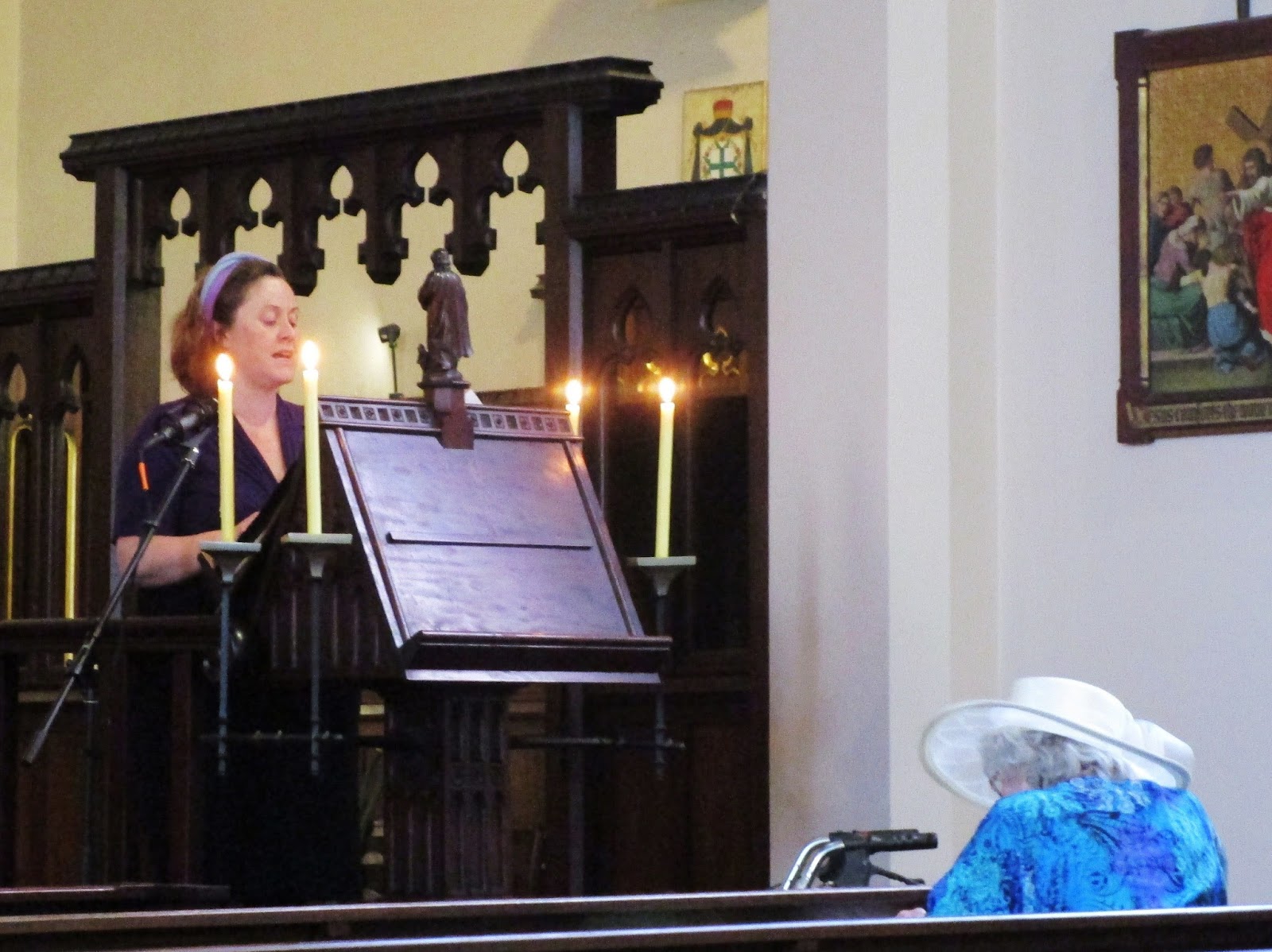
I’m a believer in cropping photographs. I don’t do much photo management: I take pictures by ambient light, flash disabled; I use a small 20 megapixel handheld digital camera; I process little. It’s my method of street photography. But I do crop. As you see, cropping changes the image from broad to intimate. The cropped version of ‘Cantor’ stresses the blue of Diana’s dress and the halo of candles surrounding Rachel, the warmth between the two women. It talks about colour. The full shot is about place, and what happens there. Rachel sings in a church that echoes the history of the colony: the city of Melbourne was proclaimed from its steps in 1848. The picture considers spaced-out churches where the aged, the disabled, the sick and the homeless — the same who came to hear Jesus — still come to hear his liturgy. It also speaks of committed musicians giving their hearts from the choir loft: here present what Britten called ‘the holy triangle’ of composer, performer, and listener. A picture about sound. Where is your field of attention? Is it close, detailed, intimate, appreciative? Or is it broad, detached, gathering experience of place and time? Which do you prefer? It was hard to decide.


Wednesday, 7 October 2015

On Sermons


Children’s author William Mayne wrote four books about the choir school of Canterbury Cathedral where he had been a pupil. In these stories choirboys could be called out for devising games to be played during the sermon. Somewhat like the joke now going around that choristers should wait for the sermon to check their mobile phones.
            Why sermons? What does a sermon do? Clearly it teaches; it has a purpose to educate often through elucidating the Scriptures. This is why you don’t interrupt a sermon. They don’t seem to be interactive. In some churches asking questions after the sermon is encouraged, but that would be disrespectful during the sermon itself. A Baptist friend told me a sermon doesn’t come from the pastor but it comes from God through the Scriptures. ‘It’s loving and it’s free,’ she said. So you listen. Every proper church service needs a sermon, or at least a homily.
            I like Dominican spirituality. ‘Praise, bless, preach.’ And what is preached is veritas: the truth. The truth is contained in the Gospel, or, rather, the Truth is Jesus Christ. Preaching this is a responsibility and an honour. Listening is a privilege and a blessing. Study, preach, listen, be present. Now.

Monday, 28 September 2015

On Learning the Collects


Children once had to learn the collect off by heart every Sunday. What value in this practice? Such memory work is no longer asked of children: reciting poetry, learning Shakespeare, learning collects. But maybe adults could ask it of ourselves.
            Collects remind us of the passage of seasons and shape of the year, something the commercial secular dimension distorts for its purposes. Some collects are very old, coming down from Late Antiquity: a collect gathers up history, without which we have no guide to this world. A collect is concise, prayer in a nutshell.
            Collects begin with a vocative: O God, Everliving God, Blessed Lord, teaching us divine address. And divine qualities follow: ‘who has caused all Holy Scriptures to be written for our learning.’ The God who does. We pray precisely: ‘keep us … from all things that may hurt us’ and for why? To accomplish the things that God would have done. In Jesus’ name, collects will conclude.
            Memorising collects can be a meditative practice. Mindfully recollecting – ‘Grant that we may in such wise hear them, read, mark, learn and inwardly digest them’ – we can return to them in times of stress, distraction, or self-criticism. It brings a touch of the divine to ordinary negativity. It places us in the divine calendar, at home in our minds.

Monday, 21 September 2015

On Compassion for the Body


In a Mindfulness course, I heard of self-compassion. Everyone suffers. Our own suffering is also worthy of compassion. Mistakes, emotions, confusions can be viewed objectively, with kindness, not subjectively with fear or a need to win.
            Compassion for thoughts and feelings, even for actions can be understood, but what about compassion for the body? St. Francis called his body ‘Brother Donkey,’ mistreating it for many years. St. Paul thought the body should be disciplined to win the race. What about those of us whose bodies cannot win?
            The body is the brain’s field of play. Movement in distant nerves, chemical exchanges, hormonal flows, relaxation states, desires, excitements, breathing, growth and aging: the brain at play. Gentleness with the body is gentleness with the brain.
            Moderation, taking care, providing safety, avoiding haste or violence are gentle behaviours. Can we show this gentleness to our suffering body? Would it make the body itself gentler, easier to manage, feeling understood and so understanding?
            Gentleness refers too to the quality of being well-born, of honourable lineage. The body has this quality: God’s image in human form. Does such a body deserve harsh treatment, impatience, or neglect? Or should a Spirit of kindness, graciousness and good temper rule our dealings with our bodies, the site of so much suffering and compassion?